
The Umbrella Problem: Why Smart Businesses Secure Financing Before They Need It
Most business owners wait too long to think seriously about financing.
They wait until payroll feels tight. They wait until inventory needs to be purchased. They wait until equipment breaks. They wait until a large customer pays late. They wait until the busy season is already here. They wait until the opportunity is urgent.
That's usually when financing gets expensive, stressful, and hard to obtain.
The better approach is simple: secure access to capital before the business urgently needs it. That doesn't mean every business should borrow recklessly, and it doesn't mean taking on debt without a plan. It means understanding that financing works best as a strategic tool, not an emergency rescue.
A business that waits until the pressure is obvious hands lenders the worst possible version of its financial picture. A business that plans early gives itself options. And in commercial financing, options create leverage.
Banks Only Give Out Umbrellas When the Sun Is Shining
There's an old saying in commercial banking: banks only give out umbrellas when the sun is shining.
It sounds unfair, but from a lender's perspective, it makes sense. Lenders don't primarily evaluate what a business owner hopes will happen next. They evaluate recent performance: cash flow, bank activity, credit strength, repayment ability, and risk.
If the most recent bank statements show declining deposits, negative days, overdrafts, low balances, missed obligations, or shrinking revenue, the lender sees stress. Even if the business had a great year six months ago, the lender's concern is what's happening now.
That's why waiting until cash flow is tight does so much damage. Businesses that wait until they fall behind are often showing lenders exactly the weakness that makes approval harder — recent transactions running negative, softening revenue, a financial picture that looks like the business isn't performing the way it used to.
The business owner sees a temporary cash crunch. The lender sees a trend. That gap is where most financing problems begin.
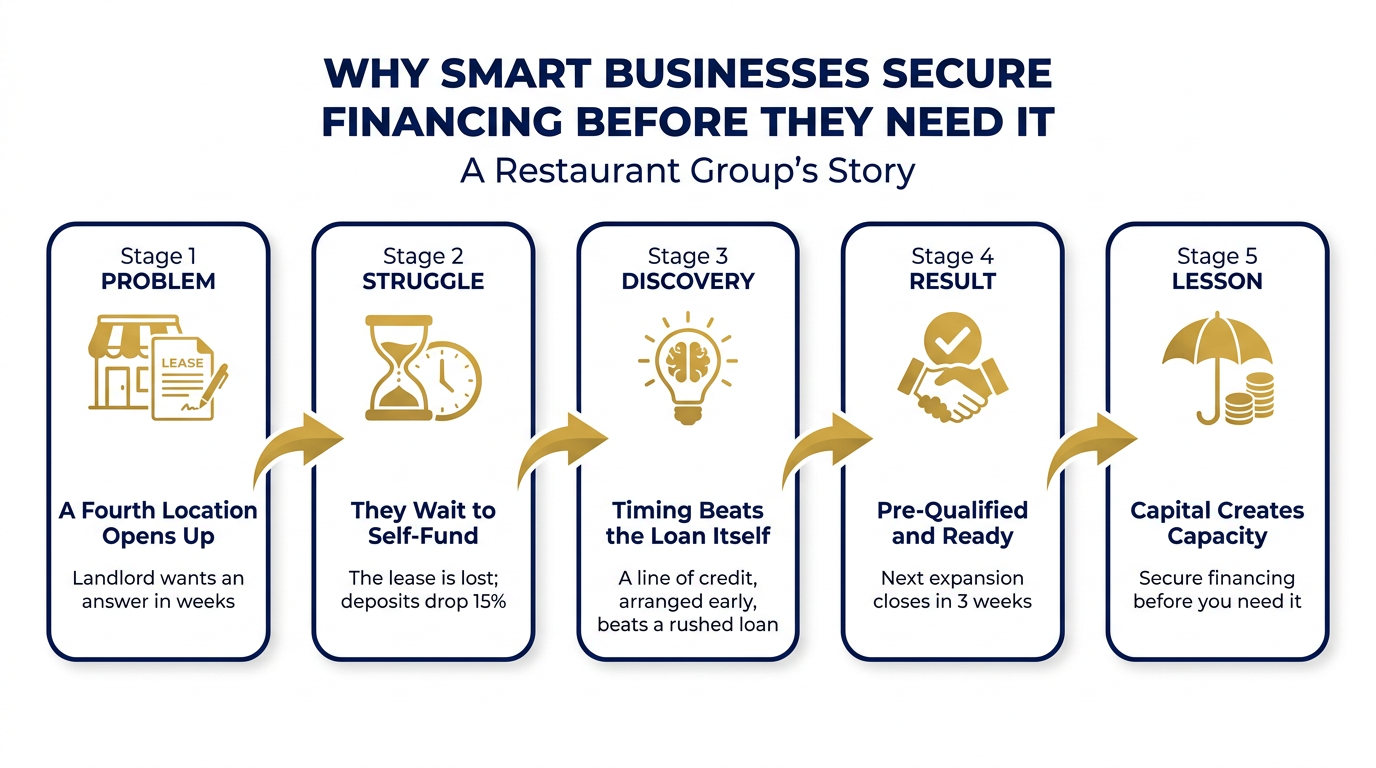
A Representative Example: How the Story Actually Plays Out
The pattern below isn't a single client file — it's a composite drawn from the kind of expansion story we see constantly among restaurant groups, contractors, and seasonal operators. It's useful because it maps cleanly onto how these situations actually unfold, beat by beat.
The problem. A regional restaurant group — three locations, steady regulars, a name people trust in their towns — gets an offer on a fourth space. A well-known spot in a neighboring town just closed, the lease is available, and the landlord wants an answer in weeks, not months. The ownership group has never had to move this fast before.
The struggle. The group's instinct is to wait until they've saved up enough from operations to fund the buildout themselves. Six months pass. The lease sits unclaimed, then gets taken by a competitor. A year later, a second opportunity appears — a bigger space, better foot traffic — but by now payroll has been tight for two straight quarters because a new competitor cut into weekday lunch traffic at location two. Deposits are down 15%. The owner starts shopping for financing for the first time, under real pressure, with bank statements that show exactly the wear you'd expect from a rough stretch.
The discovery. Working with an advisor, the ownership group learns something they hadn't considered: the financing conversation should have started when location three was still performing well, not after location two hit a rough patch. They also learn that what they assumed they needed — a lump-sum loan for buildout — isn't actually the best fit. A revolving line of credit, sized against their strongest location's cash flow and left largely undrawn, would have given them the ability to move on a lease within days instead of months, without taking on debt they didn't need yet.
The result. The group restructures. They open a pre-qualified line of credit while location three is performing well again, use a modest equipment financing package for kitchen buildout at the next opportunity, and negotiate lease terms from a position where they can move fast. The next expansion closes in three weeks instead of being lost to a faster-moving competitor.
The lesson. Growth doesn't happen only because demand exists. It happens when demand meets capacity, and capital creates capacity. The ownership group didn't need more money — they needed it sooner, structured differently, and in place before the opportunity had a deadline attached to it.
This is a representative example, not a guarantee of any particular outcome. Every business's fundability picture is different, and financing is always subject to lender approval. But the shape of the story — wait, struggle, discover the better structure, act from strength — repeats across almost every industry we work with.
What "Fundability" Actually Means
Before going further, it helps to define the term underneath all of this: fundability. Fundability is a business's overall readiness to qualify for financing — not just whether the owner's personal credit is good, but whether the business itself looks bankable on paper.
Lenders build that picture from a handful of specific signals. PAYDEX (a payment performance index that tracks how reliably a business pays its vendors, scored 0 to 100) matters more to many commercial lenders than a personal credit score, because it shows how the business behaves under its own name. Trade lines — vendor accounts that report payment history — build that score over time. DSCR (debt service coverage ratio, meaning net operating income divided by total debt payments) tells a lender whether cash flow can actually support the loan being requested, not just whether the business wants the money. LTV (loan-to-value, the loan amount as a percentage of the asset's worth) and NOI (net operating income, revenue minus operating expenses before debt service) come into play heavily on the commercial real estate side.
None of these numbers move overnight. PAYDEX improvements from new trade lines typically take 6 to 9 months of consistent payment history to show up in a meaningful way. Bank statement trends take a full quarter or two to establish a pattern a lender trusts. That's the practical reason timing matters as much as it does — fundability isn't something you can manufacture in a week, no matter how urgent the need becomes.
Financing Is About Timing, Not Just Need
Many owners think financing is only about need. "I need money for inventory." "I need money for equipment." "I need money to get through the slow season." "I need money to open another location." "I need money because payroll is coming up."
Lenders think differently. They ask whether the business is in a strong enough position to repay. That makes timing critical.
A restaurant looking to open a second location is in a very different position if it applies while revenue is strong, bank balances are healthy, and deposits are consistent. That same restaurant faces a very different outcome if it waits until construction delays, payroll strain, or a seasonal slowdown has already weakened its cash position. The opportunity may be identical. The financing outcome usually isn't.
This is especially true for seasonal businesses. Restaurants, landscapers, HVAC companies, agricultural operations, florists, retailers, construction companies, and tourism-related businesses often run on predictable cycles — Long Island restaurants, heating businesses, landscaping crews, and sports bars are classic examples of capital needs that rise and fall with demand.
But seasonality isn't limited to obvious summer or holiday businesses. Every company has a rhythm: peak sales months, slow collection periods, a major annual inventory buy, tax-season pressure, project-based cash flow swings. The smartest operators don't wait for the cycle to hurt them. They prepare before the cycle arrives.
Stress Makes Capital More Expensive
When a business owner is under pressure, the financing conversation changes. Instead of asking, "What's the best structure for this opportunity?" the owner starts asking, "How fast can I get the money?"
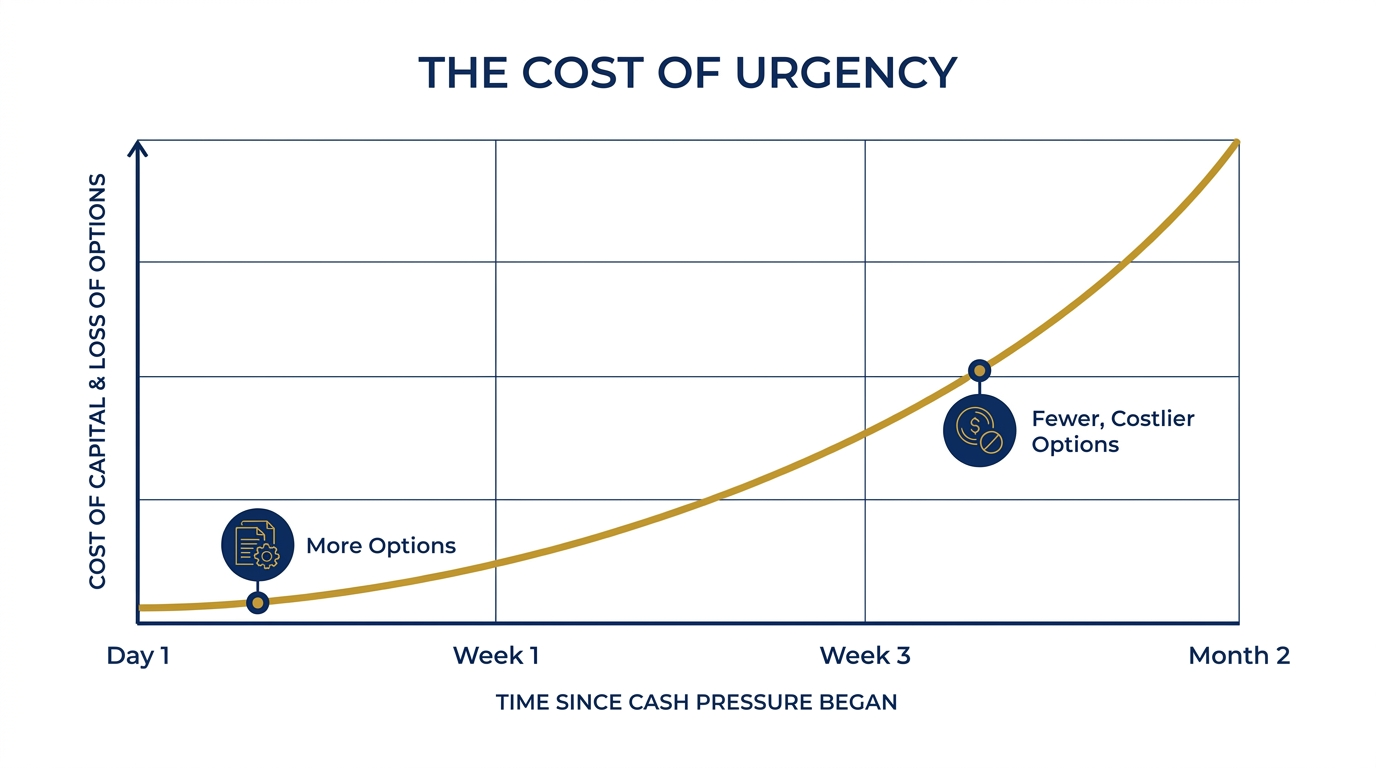
That shift is expensive. Urgency narrows options. It can push a business toward shorter terms, higher rates, daily or weekly payment structures, aggressive revenue-based financing, or products that solve today's problem while creating tomorrow's cash flow strain.
Sometimes fast capital is the right call — there are situations where speed matters more than cost. But speed should be a choice, not a consequence of poor planning.
When a business prepares early, it can actually compare options: term length, payment structure, rate, collateral requirements, and total cost of capital. The key isn't just getting approved. The key is getting the right structure. A business may walk in thinking it needs inventory financing, but after underwriting, the better answer might be equipment financing, a line of credit, invoice financing, or a term loan. That discovery process only works when the business has time to go through it.
Think of it as a curve, not a cliff. On day one of a cash crunch, a business might still qualify for a mid-cost product with reasonable terms. By week three, with two overdrafts on the books, the options shrink to whatever's left — often the most expensive capital on the market, structured around daily or weekly payments that pull cash out of the business right when it can least afford it. The business didn't become less real or less viable in those three weeks. It just ran out of time to shop, and the lender's risk math moved accordingly. Every week of delay narrows the field and raises the price of what's still available.
Opportunity Also Requires Capital
Many owners think of financing only as a defensive tool. That's a mistake. Capital isn't only for problems — it's for opportunity.
A restaurant may have the chance to open a second location. A contractor may get invited to bid on a larger project. A retailer may get access to discounted bulk inventory. An online seller may see demand spike and need inventory before revenue arrives. A manufacturer may need equipment to accept larger purchase orders. A real estate operator may need fast funds to secure a deal before competitors move.
In each case, the business doesn't merely need money — it needs readiness. That difference matters. A company with an existing line of credit or pre-qualified financing can act. A company that starts looking for capital only after the opportunity appears may miss the window entirely, the way the restaurant group above lost that first lease.
Local restaurants expanding from one town into several are a useful lens here: the ability to access capital becomes a direct reflection of the business's ability to grow.
The Most Dangerous Phrase: "We'll Deal With It Later"
Many businesses don't fail because the owner lacked talent, customers, or work ethic. They fail because cash flow timing broke the business.
A business can be profitable on paper and still be undercapitalized. It can have strong demand and still run short on working capital, receivables coming in and still miss payroll this Friday, a good expansion plan and still lose the opportunity because the financing conversation started too late.
That's why "we'll deal with it later" is dangerous. Later usually means the bank statements are weaker, credit utilization is higher, the owner is more stressed, the lender has less confidence, the available products are more expensive, and the business has less negotiating leverage.
Early financing conversations aren't about panic. They're about intelligence. They let the owner ask: What would we qualify for today? What would improve our approval odds? What documents are missing? What financing products fit our revenue cycle — a line of credit, term loan, equipment financing, invoice financing, or something else? What should we avoid? What would make us more fundable in 60 to 90 days?
That's a far better conversation than "we need money by Friday."
Strong Businesses Use Capital as a System
The best businesses don't treat financing as a one-time event. They treat it as part of their operating system.
They understand their revenue cycle. They know when deposits are strongest and when expenses spike. They track inventory needs and prepare for payroll pressure. They watch credit utilization, maintain clean books, and keep business and personal finances separate. They preserve lender confidence before they ever need to use it.
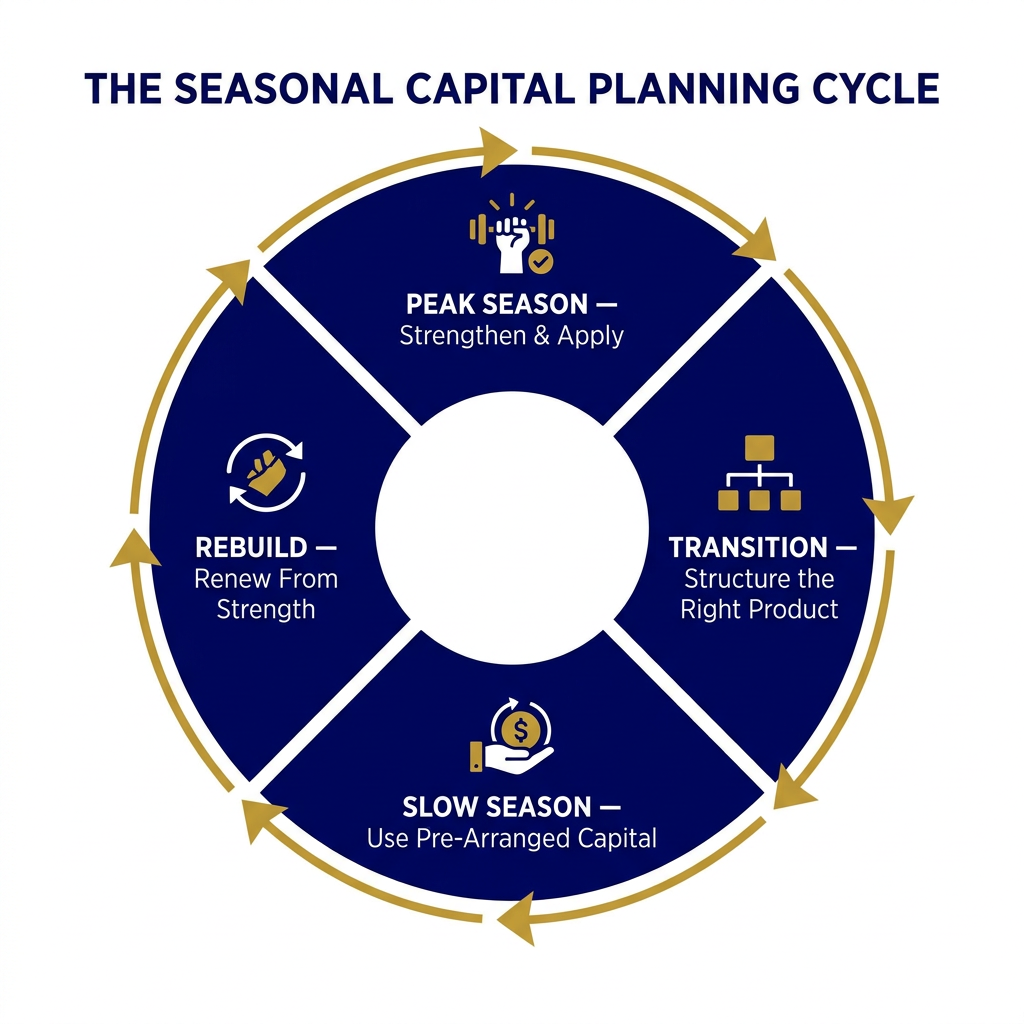
This matters most for businesses with seasonality. A seasonal business shouldn't wait until the slow season to find out whether it can get funding — it should evaluate financing when performance is strong and use that plan to prepare for predictable slowdowns or peak-season opportunities.
The most strategic operators plan for fluctuations before those fluctuations arrive. They don't wait for the worst-case scenario to prepare for the worst-case scenario. That's the mindset shift: financing shouldn't be reactive. It should be planned.
Picture the calendar as a cycle rather than a straight line. Peak season builds cash and strengthens the numbers a lender will eventually look at. That strength is the window to apply, structure a line of credit, or lock in equipment financing — not because the money is needed yet, but because this is when the business looks its best on paper. The slow season that follows is when that pre-arranged capital gets used, covering payroll and fixed costs without the owner scrambling. Then the cycle turns again, deposits rebuild, and the business re-qualifies or renews from strength instead of weakness. A business that only ever shops for financing during its slow season is, by definition, always negotiating from its weakest point of the year.
Borrowing Too Late Can Be Worse Than Not Borrowing
There's another uncomfortable truth: sometimes borrowing money when a business is already in distress makes the problem worse.
If the business doesn't have enough revenue to support the debt, financing may only delay the hard decision. If cash flow is already unstable, a high-payment product can accelerate the decline. If the owner borrows without fixing the root problem, capital becomes a bandage over a structural issue.
That's why responsible financing starts with diagnosis. Is the business facing a temporary timing gap, or a profitable opportunity? Is the issue receivables, inventory, payroll, equipment, seasonality, or margin pressure? Will capital create revenue, protect cash flow, or only cover losses? Can the business actually support the payment?
Good financing should strengthen the company's next move. It shouldn't trap the business in a cycle of expensive renewals and short-term relief. If a business is already in serious distress, borrowing may be the worst thing for it — which is exactly why the best time to assess financing is before the business reaches that point.
Questions Every Owner Should Ask Before Capital Is Needed
Business owners should ask themselves these questions on a regular cadence, not just when a crisis hits.
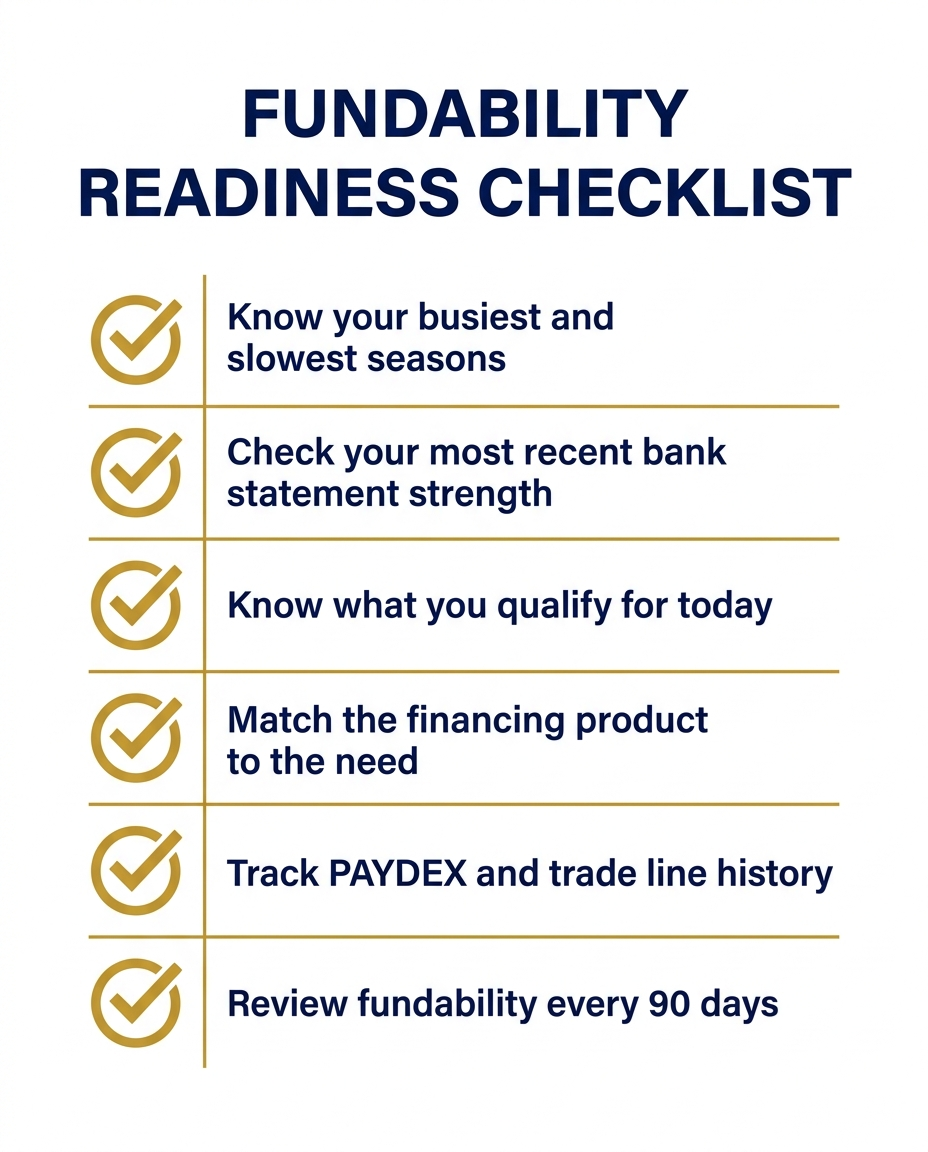
When is our busiest season, and if demand spikes, will we have enough staff, inventory, equipment, and cash to capture it? When is our slowest season, and do we have enough working capital to handle lower revenue without falling behind?
Do we ever turn away business because we lack capacity? If yes, the issue may not be demand — it may be capital structure.
Are we using the right financing product for the right need? Short-term cash flow, inventory, equipment, receivables, and expansion may each call for a different tool.
Would our most recent bank statements make us look strong to a lender? If not, the time to fix that picture is before submitting applications, not during.
Do we know what we qualify for today? Knowing your options before you need them creates leverage.
What would make us more fundable in the next 90 days? Better documentation, stronger deposits, improved credit, lower utilization, cleaner bookkeeping, and consistent cash flow can all move the needle.
These aren't one-time questions. They're worth revisiting every quarter, the same way an owner reviews a P&L or checks in on staffing. A business that runs this checklist regularly rarely gets caught flat-footed. A business that only runs it once, years ago, is usually the one calling with an urgent need and a financial picture that's already showing stress.
Financing Before You Need It Is Not Debt Addiction — It's Risk Management
Some owners resist early financing conversations because they don't want debt. That instinct is healthy. Debt should be respected.
But there's a real difference between borrowing unnecessarily and establishing access to capital intelligently. A line of credit doesn't have to be fully drawn. Equipment financing can preserve cash. Invoice financing can convert receivables into liquidity. A term loan can fund expansion with predictable payments. Together, that mix is a capital stack — the combination of financing tools a business draws on, each suited to a different need. A business that's underwriting-ready, meaning its financials and documentation are already in shape for a lender to move on quickly, can build that stack on purpose instead of assembling it one emergency at a time.
The objective isn't to borrow more. The objective is to avoid being forced into bad capital because no planning was done. A business with access to capital has choices. A business without access may have to accept whatever's available. That's the difference between strategy and survival.
The Bottom Line
The worst time to look for financing is when the business desperately needs it. By then, the lender may see declining cash flow, weaker bank activity, urgent pressure, and elevated repayment risk. That can mean fewer approvals, smaller offers, higher costs, shorter terms, and more stress for the owner.
The best time to evaluate financing is when the business is stable, bank statements are strong, revenue is consistent, and the owner has time to choose the right structure.
Capital secured early can help a business prepare for seasonal swings, capture growth opportunities, avoid emergency borrowing, strengthen cash flow, negotiate from a position of confidence, reduce stress on the owner, and protect long-term profitability.
Smart business owners don't wait until it's raining to look for an umbrella. They prepare while the sun is still shining.
If you want to know what your business would qualify for today — before you need the answer — that's a complimentary conversation, not a sales pitch. It starts with a look at where your fundability actually stands: PAYDEX, trade lines, bank activity, and how your numbers would read to a lender who's never met you. From there, the goal isn't to sell you a product. It's to tell you honestly what you'd qualify for now, what would improve that picture in the next 90 days, and which financing structure — if any — actually fits the opportunity or cycle you're planning around.
That conversation costs nothing and commits you to nothing. What it does is put you in the position every prepared business wants to be in: knowing your options before the moment arrives that forces you to need them. The earlier we look at your fundability picture, the more choices you have when it counts.
LendCraft Capital Advisors LLC provides complimentary capital advisory consultations as part of its commercial loan referral services. LendCraft is not a lender, credit counselor, or credit repair organization. Advisory services are provided at no charge. Compensation is received exclusively through referral arrangements with licensed lending partners, as disclosed prior to any referral. All financing is subject to lender approval. Terms and availability vary.