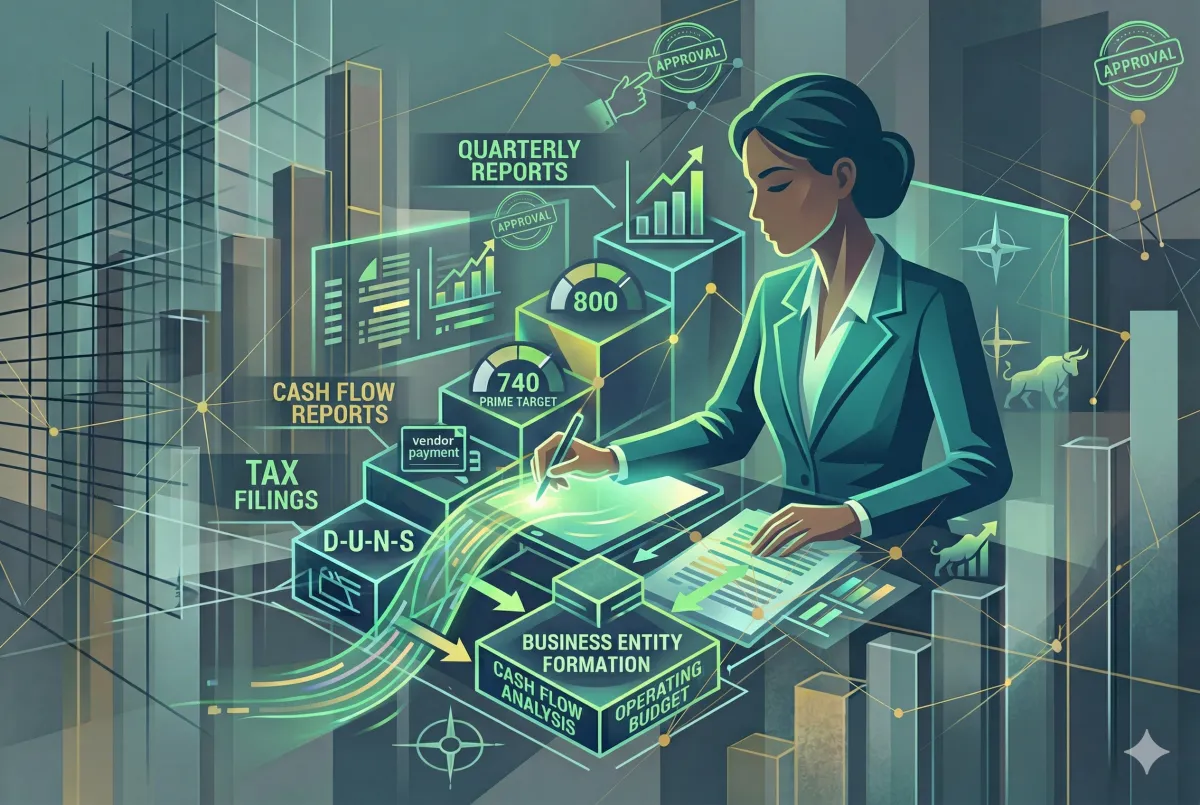
Fundability & Readiness: What It Means to Be Ready for Capital
How Your Funding Path Determines What "Fundable" Actually Means
Most borrowers think funding decisions come down to credit scores, revenue, or persistence. In reality, lenders approve loans based on fundability—a carefully aligned assessment of risk, structure, and readiness. But here's what most articles miss: fundability is not universal. What makes you fundable for a traditional bank is completely different from what makes you fundable for an alternative lender.
Understanding what fundability means for your specific funding path—and how to prepare for it—is often the difference between repeated denials and a clean approval on reasonable terms.
Fundability Is Path-Dependent
Remember the Five-Layer Financial Operating System: Layer 3 (Capital Access) includes both traditional banks and alternative lenders. They have fundamentally different definitions of fundability.
You may be fundable for a bridge lender or equipment financier but not yet fundable for a traditional bank. Conversely, a newer business with excellent cash flow may be perfectly fundable for alternative capital sources even if their credit profile is weak.
PATH A: TRADITIONAL BANK FUNDABILITY
If you're pursuing traditional institutional lending—or building toward Layer 5 (Bankability)—fundability means alignment across five comprehensive areas:
·Structure: Clean entity setup, clear ownership, personal/business separation
·Credit Profile: Strong business credit scores (PAYDEX 75+), clean payment history
·Cash Flow & Banking: Consistent, documented business deposits and balances
·Documentation: Tax returns, financial statements, clean lender-ready files
·Timing: Applying after financial data fully supports your request
For traditional banks, all five components matter equally. A weakness in any one area can trigger a decline.
PATH B: ALTERNATIVE LENDER FUNDABILITY
If you're pursuing alternative lending—equipment financing, revenue-based financing, bridge loans, merchant cash advances—fundability looks entirely different:
·Cash Flow & Business Model: Demonstrable revenue, consistent deposits, proven business traction
·Owner Experience & Background: Demonstrated competence, track record, ownership stability
·Business Fundamentals: Active operations, customer base, reasonable business model
·Documentation: Basic financial records, bank statements (not tax returns or audits)
·Credit Profile: Secondary or irrelevant. Many alternative lenders don't pull business credit at all
For alternative lenders, cash flow and business fundamentals dominate the decision. Credit scores are secondary—or not evaluated at all.
A Critical Difference: Applications & Inquiries
Traditional banks pull hard inquiries and leave footprints on credit reports. Multiple applications in a short period signal distress and damage your credit score. This is why timing and strategic application selection matter enormously for Path A.
Alternative lenders typically don't pull business credit scores. They don't generate hard inquiries. Multiple inquiries won't hurt you. This fundamentally changes the readiness calculation. You can explore multiple options without penalty.
Why Many Borrowers Are "Almost" Fundable
A common pattern: borrowers optimize for the wrong path. Examples include:
·Strong cash flow and business model, but weak business credit scores—fundable for alternative lenders (Path B), but not yet for traditional banks (Path A)
·Excellent credit scores but inconsistent cash flow documentation—fundable for traditional banks only if cash flow clarifies
·Viable business but applying too early, before financial statements fully support the request—premature for Path A; possibly fine for Path B if cash flow is strong
The mistake: assuming one lender's definition of fundability applies to all lenders. It doesn't.
What Being "Ready" Actually Means
Readiness is path-specific:
For Path A (Traditional Bank):
·Applying to the right lender (based on loan size, industry, experience)
·Applying at the right time (after financial data fully supports the request)
·Applying with clean credit scores and documentation
·Being strategic about application sequencing to avoid multiple hard inquiries
For Path B (Alternative Lending):
·Demonstrating consistent cash flow through bank statements
·Showing stable business operations and customer activity
·Being able to articulate your business model and growth trajectory
·Having basic financial records organized (not necessarily audited or polished)
Why Preparation Improves Terms—Not Just Approval
Approval is only part of the outcome. Your fundability level also determines the terms you receive.
Strongly Fundable Borrowers (High Alignment):
·Lower pricing and rates
·Fewer conditions and documentation requests
·Better structures and terms
·More flexibility and faster closing
Barely Fundable Borrowers (Minimal Alignment):
·Higher rates and pricing
·Extensive conditions and requirements
·Less favorable structures
·Slower process and more scrutiny
Fundability Is Fixable—But Know Which Path You're On
The critical point: Most fundability issues can be corrected before you apply. But what you fix depends on your path.
For Path A (Traditional Bank):
·Build business credit scores over 60–90 days
·Clean and organize financial documentation
·Improve business banking behavior and balances
·Clarify business structure and ownership
·Timeline: 90–180 days of preparation typical
For Path B (Alternative Lending):
·Demonstrate consistent cash deposits
·Organize basic financial records and bank statements
·Clarify your business model and owner background
·Show stable, active business operations
·Timeline: 30–60 days of preparation typical
The Bottom Line
Lenders don't approve loans because borrowers ask well. They approve loans because the risk profile makes sense for their lending criteria. Understanding fundability—and knowing which lender's definition applies to your situation—gives you control over the outcome instead of hoping for one.
Know Where You Stand
Take the Capital Assessment: Visit our Business Funding page to evaluate your fundability across all five layers of the financial operating system. Discover which path aligns with your current position and what your next immediate step should be.
This article is for educational purposes only and does not constitute a loan offer or guarantee of funding. LendCraft Capital Advisors LLC provides complimentary capital advisory consultations as part of its commercial loan referral services. LendCraft is not a lender, credit counselor, or credit repair organization. Advisory services are provided at no charge. Compensation is received exclusively through referral arrangements with licensed lending partners, as disclosed prior to any referral. All financing is subject to lender approval. Terms and availa
